Could moons beyond our solar system support life as we know it? This is what a recent study published in the Monthly Notices of the Royal Astronomical Society hopes to address as an international team of scientists investigated the potential habitability of exomoons orbiting free-floating planets (FFPs). This study has the potential to help scientists provide better constraints for where to search for life beyond Earth, along with the conditions for life to emerge.
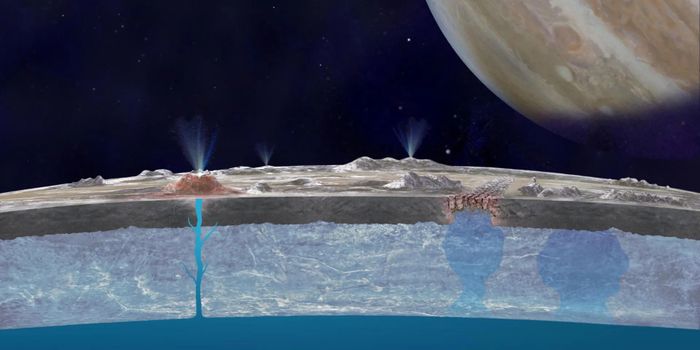
For the study, the researchers conducted a series of computer models to simulate how tidal heating could occur on exomoons orbiting FFPs after both have been ejected from their original star systems. Tidal heating occurs when a smaller object with an eccentric (non-circular) orbit is stretched and compressed by a larger object it’s orbiting. Within our solar system, this occurs with the Galilean moons, specifically Io and Europa, as they orbit the much larger Jupiter.
As Io orbits Jupiter, it is closer and farther away during certain points of its orbit, resulting in its stretching and compression, which leads to friction and heating of its interior. As a result, Io boasts hundreds of active volcanoes and is the most volcanically active body in the solar system. For Europa, not only is its tidal heating influenced by Jupiter, but also the other Galilean moons, since Europa is the second innermost moon with Io being the innermost.
In the end, the researchers’ simulations revealed that exomoons with primarily hydrogen atmospheres and consisting of nitrogen, carbon, and oxygen can trap enough heat for liquid water to exist for up to 4.3 billion years. Along with identifying that exomoons orbiting FFPs could support life, the findings also helped put constraints on life’s origins.
“Our collaboration with the team of Professor Dieter Braun helped us recognize that the cradle of life does not necessarily require a sun,” said David Dahlbüdding, who is a PhD student at Ludwig Maximilian University of Munich (LMU) and lead author of the study. “We discovered a clear connection between these distant moons and the early Earth, where high concentrations of hydrogen through asteroid impacts could have created the conditions for life.”
What new insight into exomoon life will researchers make in the coming years and decades? Only time will tell, and this is why we science!
As always, keep doing science & keep looking up!
Sources: Monthly Notices of the Royal Astronomical Society, EurekAlert!
Featured Illustration Credit: NASA