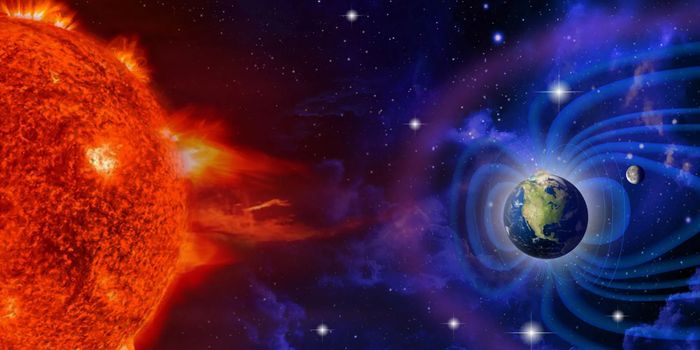
How does the Sun’s magnetic field react during solar storms? This is what a recent study published in The Astrophysical Journal Letters hopes to address as a team of scientists led by the Southwest Research Institute investigated the processes the Sun’s magnetic field undergoes during solar activity, specifically solar wind. This study has the potential to help scientists better understand and predict space weather, which can wreak havoc on satellites and ground stations.
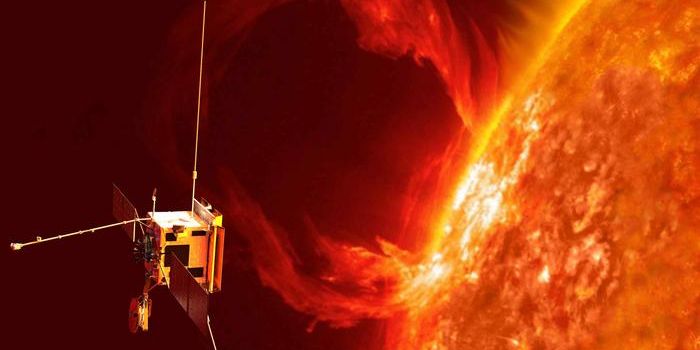
For the study, the researchers analyzed data obtained from NASA’s Parker Solar Probe, which has been studying the Sun up-close since 2018. The motivation behind the study was to fill knowledge gaps between longstanding theoretical models of the Sun’s magnetic field processes and real-world observations. To accomplish this, Parker flew within approximately 16.25 solar radii from the Sun, or approximately 7 million miles away. For context, the planet Mercury orbits the Sun at an average distance of approximately 36 million miles, so Parker was flying more than five times closer than Mercury average distance from the Sun.
In the end, the researchers discovered the processes driving the Sun’s magnetic field, especially during solar storms, are far more complex than previously thought. For example, the researchers found that solar storms drastically increase the speed of charged particles from the Sun, resulting from a phenomenon called magnetic reconnection. This is when the Sun’s magnetic field acts like a stretched-out rubber band, and when it snaps, this shoots out charged particles.
“What we are learning is that the Sun’s ‘magnetic engine’ is far more complex than we imagined,” said Dr. Mihir Desai, who is the Director of the Department of Space Research at the Southwest Research Institute and lead author of the study. “This is incredibly exciting because it demonstrates that our own star acts as a local, accessible laboratory for the same high-energy physics — like particle acceleration and magnetic snapping — that powers the most violent and mysterious phenomena in the universe, from black holes to supernovae.”
What new insight into the Sun’s magnetic field will researchers make in the coming years and decades? Only time will tell, and this is why we science!
As always, keep doing science & keep looking up!
Sources: The Astrophysical Journal Letters, EurekAlert!
Featured Illustration: NASA