How can graphics processing units (GPUs) be improved for advanced computing efficiency? This is what a recent study published in Nature Communications hopes to address as a team of researchers from the University of California, San Diego (UC San Diego) investigated how a new type of converter could revolutionize chip design. This study has the potential to provide a gateway for advanced computing, which comes as data centers are rapidly expanding across the country.
For the study, the researchers introduced a novel concept for improving a longtime computer component called a DC-DC step-down converter, which enables computer circuits to operate safely by reducing the amount of voltage. However, their needs have become constrained with greater computing power due to data centers and artificial intelligence. To address this, the researchers introduced piezoelectric resonators, which use mechanical vibrations to both store and transfer energy.
Combining these piezoelectric resonators with traditional capacitors, the researchers found that the new combination successfully decreased voltage from 48 volts to 4.8 volts while maintaining 96.2 percent efficiency. This number of volts is commonly used in data centers, thus demonstrating its capabilities for growing data centers nationwide.
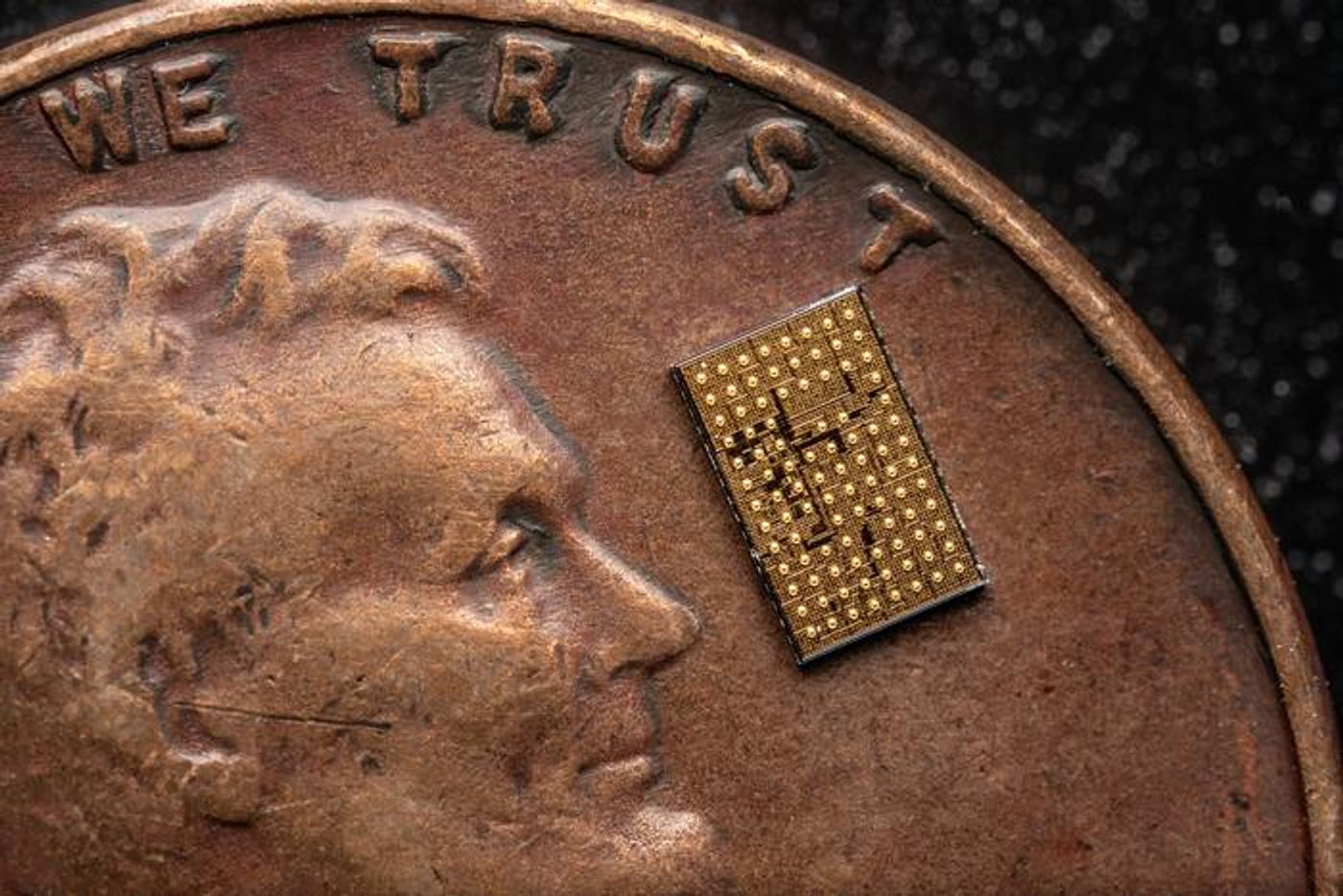
Credit: David Baillot/UC San Diego Jacobs School of Engineering
“Piezoelectric-based converters aren’t quite ready to replace existing power converter technologies yet,” said Dr. Patrick Mercier, who is a professor in the Department of Electrical and Computer Engineering at UC San Diego and a co-author on the study. “But they offer a trajectory for improvement. We need to continue to improve on multiple areas — materials, circuits and packaging — to make this technology ready for data center applications.”
This study comes as AI data centers being built across the country are currently dealing with a power issue. This is because their construction utilizes traditional electrical engineering, whereas this study introduces a hybrid mechanical-electrical approach.
How will piezoelectric resonators help advance computing in the coming years and decades? Only time will tell, and this is why we science!
As always, keep doing science & keep looking up!
Sources: Nature Communications, EurekAlert!