How can soft robots be enhanced while reducing the need for gears and motors? This is what a recent study published in Advanced Functional Materials hopes to address as a team of scientists investigated how heat could be used to control the movement of soft robotics. This study has the potential to help scientists develop new and exciting methods for enhancing soft robotics, which hold a myriad of industrial and commercial applications.
For the study, the researchers introduced a novel method soft-rigid hybrid robot design that doesn’t need traditional gears and motors for movement. To accomplish this, the team used a combination of flexible printed circuit boards and 3D printed liquid crystal elastomers, enabling the soft robots to fold and morph like origami. Additionally, the design uses heat to maximize range of motion. The motivation behind this study was to develop soft robotics that exhibit both high performance and ease of manufacturing. In the end, the researchers successfully demonstrated their new design could withstand more than 1,500 uses while experiencing minimal wear-and-tear and reduced efficiency.
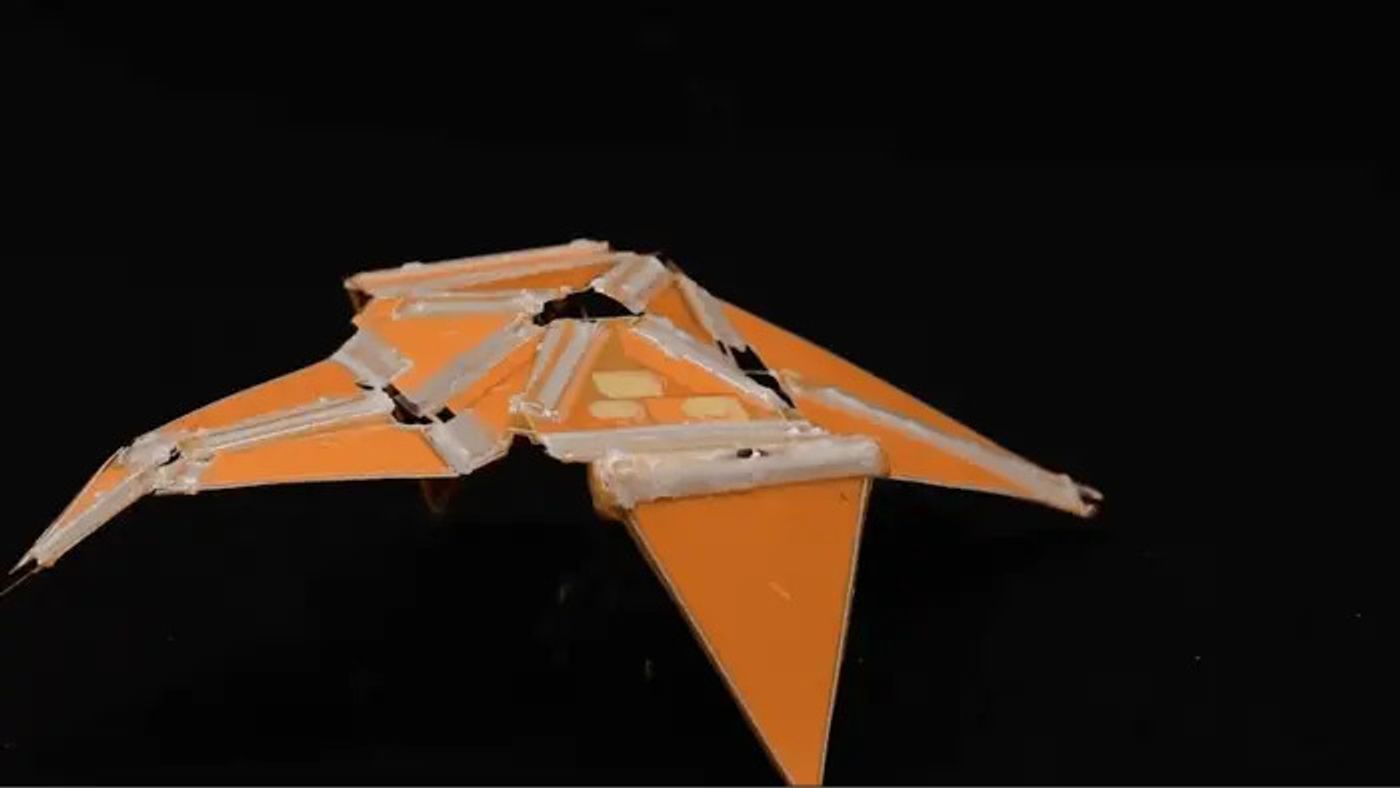
Credit: Princeton University
The study notes, “Ultimately, we envision that the approach articulated here could enable low cost, high throughput, and highly replicable fabrication of self-folding origami. The creation of such standardized self-folding origami ‘unit cells’ could be utilized for the creation of dynamically reconfigurable metamaterials as well as the creation of ‘swarms’ of robotic unit cells with emergent behaviors.”
This study comes as the field of soft robotics continues to advance, with soft robots being capable of enduring environments that traditional robots can’t ensure. This includes healthcare and biomedical, environmental exploration, space exploration, and human-computer interaction, just to name a few.
How will soft-rigid hybrid robots help enhance soft robotics in the coming years and decades? Only time will tell, and this is why we science!
As always, keep doing science & keep looking up!
Sources: Advanced Functional Materials, EurekAlert!