When did Jupiter’s Galilean moons first contain the ingredients for life? This is what complementary studies published in The Planetary Science Journal and Monthly Notices of the Royal Astronomical Society hopes to address as an international team of scientists investigated potential timescales for when three of Jupiter’s Galilean moons, Io, Europa, Ganymede, and Callisto, could have first formed the ingredients for life. This study has the potential to help scientists better understand the formation and evolution of the Galilean moons and what this could mean in the search for life beyond Earth.
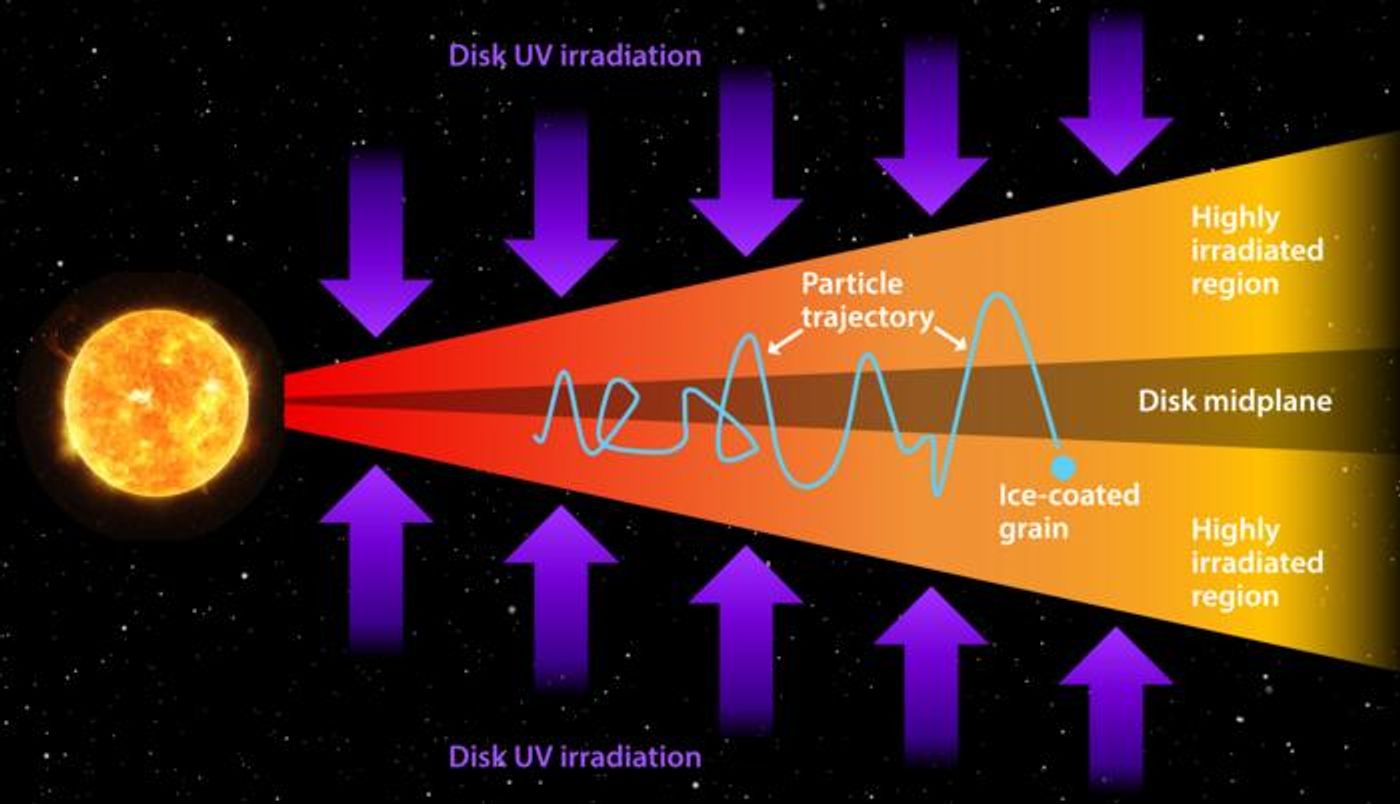
For the studies, the researchers explored the formation of complex organic molecules (COMs) within Jupiter’s original disk of gas, dust, and ice, also called the circumplanetary disk, along with modeling how COMs could be delivered to the Jupiter system from the protoplanetary disk that formed the Sun and planets. They examined how interaction with ultraviolet radiation from the Sun could influence COM formation. The overarching goal of both studies was to ascertain both how and when Jupiter’s Galilean moons received the ingredients for life, specifically focusing on icy grains that currently comprise Europa, Ganymede, and Callisto.
In the end, the researchers found that icy grains could have obtained COMs and delivered them to Jupiter’s moons both within Jupiter’s circumplanetary disk and from the solar system’s protoplanetary disk. Additionally, the models showed that approximately half of the simulated icy grains could have formed within the solar system’s protoplanetary disk and were delivered to Jupiter’s moons. Finally, the researchers estimated these processes occurred billions of years ago during the early formation of the solar system.
Credit: Southwest Research Institute
“Our findings suggest that Jupiter’s moons did not form as chemically pristine worlds,” said Dr. Olivier Mousis, who is a scientist at the Southwest Research Institute, and is lead author of one study and a co-author on the other study. “Instead, they may have accreted, or accumulated, a significant inventory of COMs at birth, providing a chemical foundation that could later interact with the liquid water in their interiors. Establishing credible pathways for COMs formation and delivery provides scientists with a critical framework for interpreting upcoming measurements of Jupiter’s surface and subsurface chemistry.”
What new insight into the formation of life’s ingredients on Jupiter’s Galilean moons will researchers make in the coming years and decades? Only time will tell, and this is why we science!
As always keep doing science & keep looking up!
Sources: The Planetary Science Journal, Monthly Notices of the Royal Astronomical Society, EurekAlert!