How can Martian regolith (often mistakenly called “soil”) be used to benefit human exploration? This is what a recent study published in the International Journal of Astrobiology hopes to address as a team of scientists investigated how tardigrades (also called “water bears”) could be used to sterilize the Martian regolith for improved functionality, specifically for growing plants. This study has the potential to help scientists, engineers, mission planners, and future astronauts develop new methods for eventually living on Mars and long-term settlements.
For the study, the researchers examined states of two types of tardigrades responded to long-term exposure to Martian regolith simulant known as MGS-1 and OUCM-1, which the researchers note are like the regolith examined by NASA’s Curiosity rover. The purpose of a simulant is necessary since Mars regolith samples has never been returned to Earth. Tardigrades are known for their extreme resilience and scientists have established they have two types of states: active and dormant, as opposed to alive and dead.
The goal of the study was to ascertain if tardigrades could be used to improve the chemical composition of Martian regolith. However, the researchers discovered that the MGS-1 caused significant declines in tardigrade activity after only a few days. The team mitigated this by washing the simulant and introduced new tardigrades, resulting in improved numbers. For OUCM-1, the researchers found this simulant also caused increased tardigrade dormancy while one type of tardigrade was less damaging.
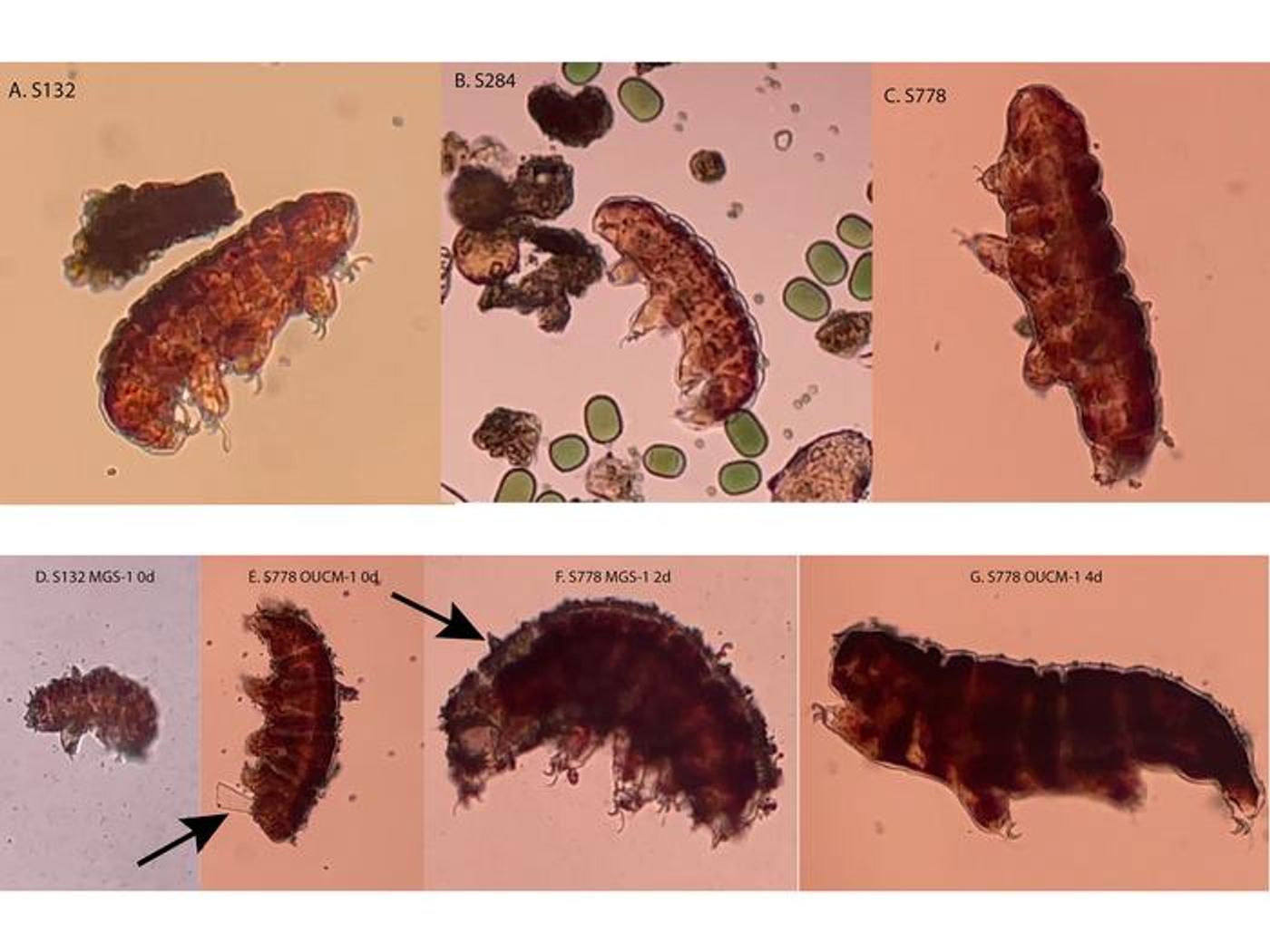
Microscopic images of tardigrades in Earth sand (top 3) and Martian regolith (bottom 4). (Credit: Corien Bakermans/Penn State)
“It seems that there’s something very damaging in MGS-1 that can dissolve in water — maybe salts or some other compound,” said Dr. Corien Bakermans, who is a professor of microbiology at Penn State University and lead author of the study. “That was unexpected, but it’s good in a sense, because it means that the regolith’s defense mechanism could stop contaminants. At the same time, it can be washed to help support plant growth or prevent damage to humans who come in contact with it.”
This study complements a growing list of research exploring how humans could both live and survive on the Red Planet using available resources, also called in situ resource utilization (ISRU). Improving ISRU could significantly reduce the need for re-supplies from Earth, specifically from food and water.
How will tardigrades help improve Martian regolith functionality and human habitats in the coming years and decades? Only time will tell, and this is why we science!
As always, keep doing science & keep looking up!
Sources: International Journal of Astrobiology, EurekAlert!