What happens to Mars’ atmosphere when it gets hit with space weather? This is what a recent study published in Nature Communications hopes to address as a team of scientists investigated novel methods for studying Mars’ atmosphere when it encounters a solar event. This study has the potential to help scientists better understand the role of space weather in planetary atmospheres and what this could mean for finding life beyond Earth.
For the study, the researchers analyzed data obtained from two Mars orbiters, Mars Express and ExoMars Trace Gas Orbiter (TGO) that encountered a solar storm striking the Martian upper atmosphere in May 2024. Using a technique called radio occultation, which involves studying how radio waves interact with a planet’s atmosphere as they pass through it, the researchers beamed a radio signal from Mars Express to TGO as the latter was passing behind the planet and out of range.
Through this, the team discovered substantial increases in electron activity at altitudes of 110 and 130 kilometers (68 and 80 miles) of 45 percent and 278 percent, respectively. The researchers note these findings could shed better light on the climate history of Mars, specifically how it lost its water and atmosphere long ago.
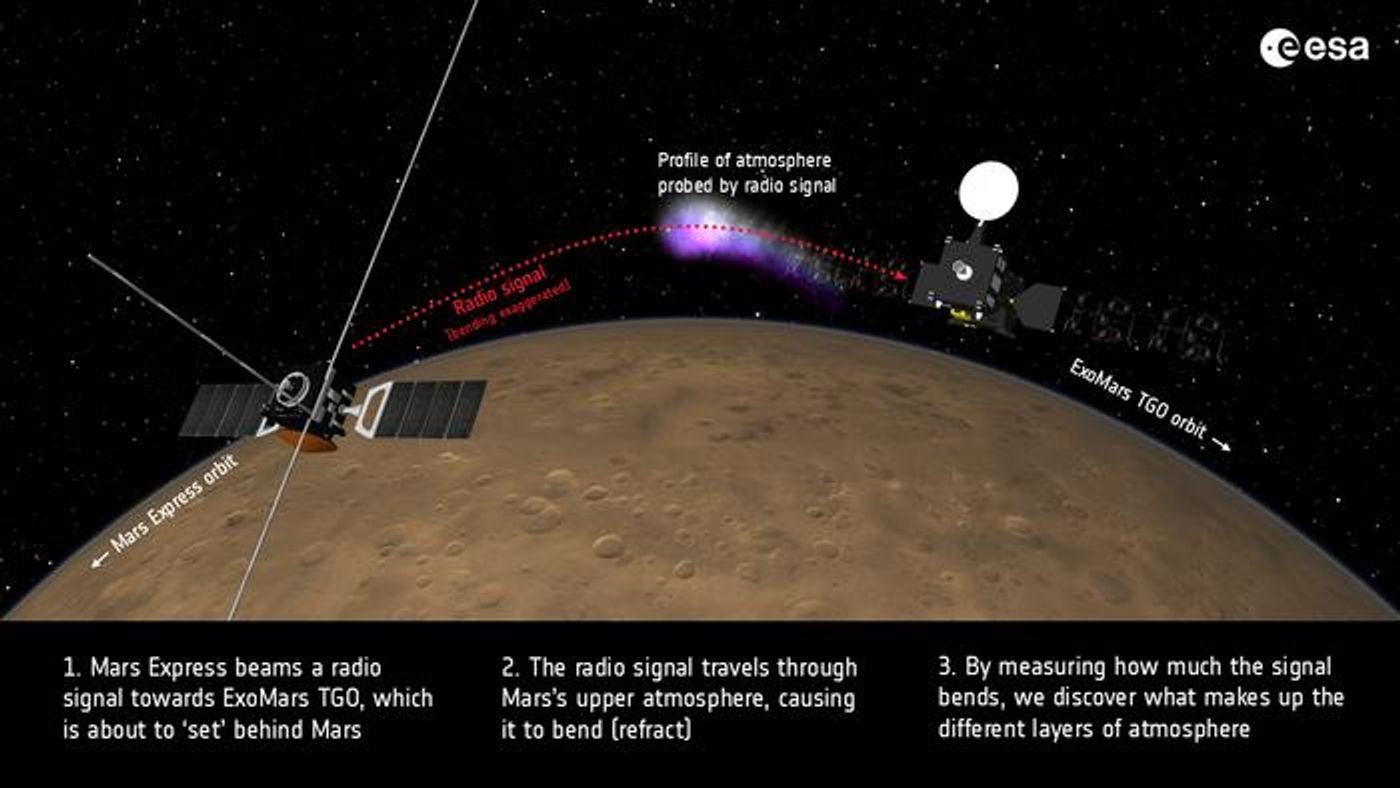
Credit: European Space Agency
“But there’s another side to it: the structure and contents of a planet’s atmosphere influence how radio signals travel through space,” said Dr. Colin Wilson, who is a European Space Agency project scientist for both orbiters and a co-author on the study. “If Mars’s upper atmosphere is packed full of electrons, this could block the signals we use to explore the planet’s surface via radar, making it a key consideration in our mission planning – and impacting our ability to investigate other worlds.”
What new insight will researchers make regarding space weather and planetary atmospheres in the coming years and decades? Only time will tell, and this is why we science!
As always, keep doing science & keep looking up!
Sources: Nature Communications, EurekAlert!