Tuberculosis (TB) is the world’s leading cause of death from a single infectious agent, affecting more than 10 million people each year and caused and estimated 1.25 million deaths in 2023.1,2 While TB is treatable with first-line antibiotics, drug-resistant TB (DR-TB) has emerged as a growing global threat, driven by factors such as bacterial gene mutations and challenges from incomplete or inadequate antibiotic treatment. Managing DR-TB is complex, often requiring longer treatment durations, stronger medications, and routine monitoring, with limited certainty about the optimal approach for individual patients.
Conventional diagnostics, including nucleic acid amplification tests (NAATs) and culture-based testing, provide valuable information but are limited in scope. NAATs often target only a subset of known mutations, potentially missing low-frequency or emerging resistance variants, which can lead to delayed or suboptimal treatment decisions. The World Health Organization (WHO) now recommends incorporating targeted next-generation sequencing (tNGS) into national DR-TB algorithms, emphasizing its utility in accelerating diagnosis, improving treatment precision, and enhancing surveillance capabilities.
To address these challenges, national TB programs and medical professionals are turning to tNGS Unlike traditional diagnostics, tNGS focuses on the genes associated with drug resistance, rather than lengthy culture-based methods or methods with limited drug targets. This approach offers advantages such as the detection of low-frequency variants, faster turnaround times, actionable insights for clinicians, and can offer cost-effectiveness compared to current testing algorithms.
This article explores the role of tNGS in DR-TB control through real-world country experiences. Drawing on insights from a six-part webinar series featuring national TB programs in Indonesia, Namibia, Kyrgyzstan, Eswatini, South Africa, and Mexico we highlight motivations for adoption, integration into testing algorithms, practical implementation, and clinical outcomes.3
The Imperative for Better DR-TB Diagnostics
Globally, DR-TB continues to challenge efforts to end tuberculosis, accounting for significant morbidity, mortality, and programmatic complexity. In high-burden countries like Indonesia, DR-TB prevalence has prompted urgent action to strengthen diagnostic capabilities. Similarly, Namibia, facing concentrated DR-TB cases within specific populations, recognized the need for timely and accurate resistance detection to guide effective treatment.
For countries like Indonesia and Namibia, prioritizing tNGS addresses both clinical and programmatic gaps. By detecting drug resistance earlier and more comprehensively, national programs can reduce treatment failures, prevent the development of further resistance, and optimize resource allocation.
Figure 1: Five phases of NGS implementation in six different countries from initial setup to sustainable use.
Motivations and Early Steps
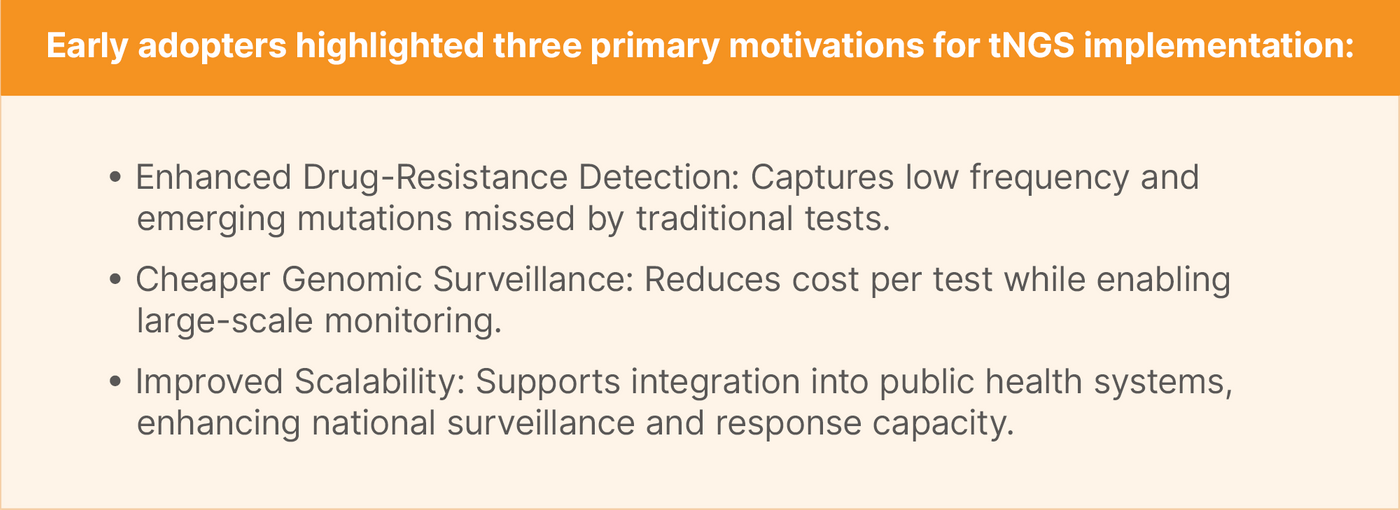
There are several factors that are driving the push towards tNGS. Countries with high DR-TB incidence are interested in obtaining results for more anti-TB drugs and with faster time-to-results which tNGS provides. Nations are also interested in instruments that can test other infectious and non-infectious diseases; NGS technology provides this as well.
Policy commitments towards integrating genomic surveillance into public health systems are another driving force behind tNGS adoption. These policies were enacted in response to the COVID-19 pandemic, which put increased emphasis on genomic infrastructures. This enables more efficient monitoring of disease outbreaks, including TB. This is because tNGS offers improved scalability, and actionability to address TB and other infectious diseases.
Figure 2: Primary motivations for tNGS implementation.
By addressing these clinical, operational, and policy drivers, countries can take early steps toward a sustainable, data-driven approach to DR-TB control, laying the foundation for long-term impact.
Integration into National Algorithms
Integrating tNGS into national TB testing algorithms requires alignment with existing diagnostic workflows while maximizing clinical impact. Sequencing results can guide treatment decisions, enabling clinicians to identify resistance patterns that standard tests may not reveal. By complementing culture and molecular TB tests, tNGS strengthens the diagnostic pathway, reducing time to appropriate therapy and supporting precision medicine approaches. In Indonesia, tNGS was deployed during a pilot implementation phase for patients with confirmed or suspected DR-TB who tested positive on rapid molecular TB assays.
Namibia, now in the integration phase, demonstrates a more mature implementation model. The national program employs tNGS for selected high-risk populations, using sequencing data to inform individualized treatment regimens and national surveillance strategies. tNGS is ordered after initial rapid testing and is interpreted alongside phenotypic culture results and epidemiological data.
Successful integration across national programs depends on multidisciplinary collaboration, effective data management, and continuous training. Ensuring that sequencing results are actionable requires coordination between laboratory staff, clinicians, and program managers. By embedding tNGS into diagnostic workflows, programs create a streamlined pathway from sample collection to patient-centered care, strengthening overall DR-TB control and supporting national targets for disease reduction.
Building the NGS Lab: From Theory to Practice
Establishing an operational NGS laboratory involves careful planning, sustained funding, infrastructure investment, and workforce training. In Indonesia, pilot-phase implementation focused on leveraging existing hospital facilities, optimizing sample preparation workflows, and deploying automated extraction systems to enhance throughput and reduce error. Similarly, Namibia prioritized building a scalable lab model with modular automation, standardized protocols, and robust quality control measures.
Key considerations include workflow optimization, instrument selection, and staff competency development. Automation and extraction systems streamline sequencing processes, minimizing turnaround time and labor requirements. Staff training emphasizes both technical skills and data interpretation, ensuring results are accurate, actionable, and integrated into clinical decision-making.
Early hurdles, such as supply chain management, instrument calibration, and data integration challenges, were addressed through phased implementation, mentorship programs, and collaboration with experienced sequencing partners. By approaching lab setup systematically, programs in both Indonesia and Namibia reduced operational risk and created a sustainable foundation for ongoing NGS adoption.
Clinical Case Examples
"The introduction of the targeted next-generation sequencing, has been transformative, It's not just a lab innovation, but it's a clinical empowerment tool.” -Dr. Heidy Agustin, M.D., Ph.D.
Real-world patient experiences underscore the clinical impact of tNGS. In Indonesia, tNGS identified a rare resistance mutation in the M. tuberculosis strain infecting a patient who had previously received multiple rounds of first-line therapy. Rapid detection enabled clinicians to tailor a second-line regimen promptly, preventing further disease progression and reducing the risk of transmission.
“So now with the technology of tNGS, I can receive a comprehensive resistant profile within a few days.” - Dr. Heidy Agustin, M.D., Ph.D.
As Dr. Heidy Agustin, M.D., Ph.D., noted, "the introduction of the targeted next-generation sequencing, has been transformative, It's not just a lab innovation, but it's a clinical empowerment tool." With tNGS, clinicians like Dr. Agustin, who rely on limited molecular testing or slow phenotypic drug susceptibility testing that often takes weeks to yield results, now have another option. “So now with the technology of tNGS, I can receive a comprehensive resistant profile within a few days.”
"tNGS creates an avenue for Namibia for molecular diagnostics, not only focusing on TB, but also potentially expanding to other areas like other infectious diseases and cancer.” -Dr. Emmanuel Nepolo, Associate Professor University of Namibia
Beyond information at individual patient levels, tNGS provides epidemiological insights that inform public health strategy. Dr. Agustin says that “knowing the strain lineage and mutation pattern also informs me as a clinician about likely transmission chains and whether the resistance is primary or acquired, and also the potential of local outbreaks.” The targeted nature of this method helps clinicians like Dr. Agustin to support early and precise treatments while avoiding trial and error in treatment strategy.
In Namibia, sequencing revealed low-frequency drug-resistant variants in a high-risk population, prompting adjustments in treatment that would not have been possible with conventional tests alone. This early intervention not only improved patient outcomes but also strengthened national surveillance data, informing public health decisions and resource allocation.
Dr. Emmanuel Nepolo, Associate Professor University of Namibia also supports the method, saying that it’s not only easy to implement without interfering with established diagnostic workflows, but that it can enhance detection of DR-TB, optimize patient management and treatment regimen, and shorten drug resistance result turnaround time. To Dr. Nepolo, “tNGS creates an avenue for Namibia for molecular diagnostics, not only focusing on TB, but also potentially expanding to other areas like other infectious diseases and cancer.”
In Summary
These examples highlight how tNGS can bridge gaps in diagnostics, enabling faster, more precise treatment interventions and reinforcing the value of sequencing in routine DR-TB management. Watch the full webinar series to follow the later phases of tNGS implementation in South Africa, Mexico, and more, available here.
Across both pilot and integration experiences, several practical recommendations emerge for national TB programs:
Leverage existing infrastructure: Integrate tNGS with current molecular testing to maximize efficiency.
Prioritize staff training: Develop multidisciplinary teams capable of handling both sequencing and clinical interpretation.
Phase implementation: Begin with high-risk populations or pilot sites before scaling nationwide.
Collaborate with partners: Engage sequencing technology providers, public health agencies, and academic institutions to streamline adoption and troubleshoot early challenges.
Use data strategically: Translate sequencing results into actionable treatment decisions and programmatic policies.
Programs that followed these principles report faster turnaround times, enhanced resistance detection, and improved patient outcomes. At the same time, continuous evaluation and iterative improvements help refine workflows, optimize lab operations, and ensure alignment with WHO recommendations.
National TB programs and healthcare leaders seeking to accelerate DR-TB control can leverage tNGS to strengthen diagnostics, help improve treatment outcomes, and enhance surveillance.
Explore best practices from Indonesia and Namibia, connect with expert teams, and access resources to guide implementation planning. To gain deeper insights and actionable strategies, attend the full six-part Illumina tuberculosis webinar series and learn how to translate WHO recommendations into practical, country-specific solutions.
Illumina is a leading developer, manufacturer, and marketer of life science tools and integrated systems dedicated to making genomics useful for all. Innovating at the intersection of technology, biology, and health, we are reimagining what's possible for human health and the health of our planet, including how diseases are discovered, detected, diagnosed, and treated. We provide sequencing innovations that are enabling researchers and clinicians to usher in the future of personalized medicine.