What can a planet being larger than its star teach astronomers about planetary formation and evolution? This is what a recent study published in The Astronomical Journal hopes to address as a team of researchers investigated how giant planets form around smaller stars than our Sun. This study has the potential to help scientists better understand planetary formation and evolution and solar system architecture.
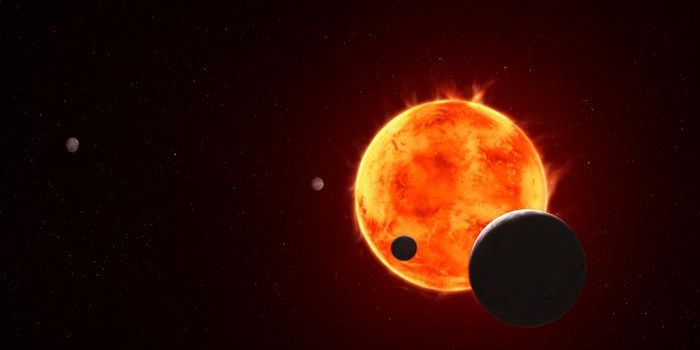
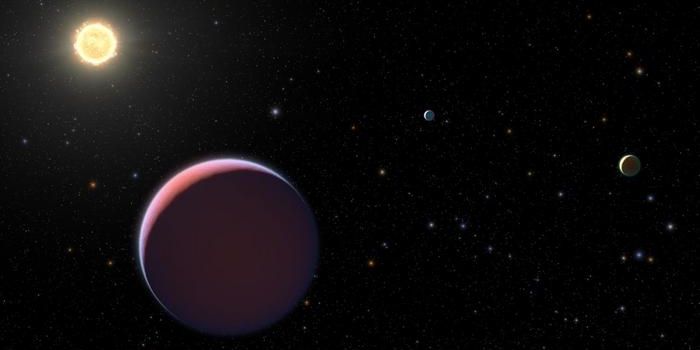
For the study, the researchers used NASA’s James Webb Space Telescope (JWST) to observe transits of TOI-5205 b, which is located approximately 280 light-years from Earth and whose mass and radius is approximately the size of Jupiter. What makes TOI-5205 b unique is it orbits an M-dwarf star, which has a mass and radius approximately 40 percent of our Sun. Along with their smaller size, M-dwarf stars are also colder than our Sun. The goal of the study was to examine TOI-5205 b’s atmospheric composition and compare it to planetary interior models of TOI-5205 b.
In the end, the researchers found that TOI5205 b’s atmospheric composition is opposite to what we observe in our solar system, specifically for Jupiter. While Jupiter is primarily composed of hydrogen, its atmosphere also contains large amounts of heavy metals, also called metallicity. In contrast, the atmosphere of TOI-5205 b contains a smaller ratio of heavy metals, along with evidence of methane and hydrogen sulfide. The team also found TOI-5205 b’s metallicity is lower than its host star, which is very uncommon, and models showed its interior has a metallicity 100 times higher than its atmosphere.
“We observed much lower metallicity than our models predicted for the planet’s bulk composition, which is calculated from measurements of a planet’s mass and radius,” said Dr. Shubham Kanodia, who is a Postdoctoral Fellow at Carnegie Science and a co-author on the study. “This suggests that its heavy elements migrated inward during formation and now its interior and atmosphere are not mixing. In summary, these results suggest a very carbon-rich, oxygen-poor planetary atmosphere.”
What new insight into giant planets orbiting M-dwarf stars will researchers make in the coming years and decades? Only time will tell, and this is why we science!
As always, keep doing science & keep looking up!
Sources: The Astronomical Journal, EurekAlert!
Feature Illustration Credit: Katherine Cain, Carnegie Science