Can autonomous robots help cut space exploration times? This is what a recent study published in Frontiers in Space Technologies hopes to address as a team of scientists from Switzerland and the Netherlands investigated how semi-autonomous robots could be used to explore the surfaces of the Moon and Mars. This study has the potential to help scientists, engineers, and future astronauts use robots for exploration purposes while limiting risk to human explorers.
For the study, the researchers introduced the legged robot ANYmal with numerous scientific instruments, including a microscopic imager (MICRO) and Raman spectrometer on a robotic arm. ANYmal was tested in analog sites meant to mirror the surfaces of the Moon and Mars. The primary motivation behind the study was to overcome operational limitations with human-controlled, single-target methods for robotic exploration. Essentially, a semi-autonomous robot could alleviate human intervention, thus freeing up time and resources for human tasks.
The primary goal of this study was to ascertain the capabilities of ANYmal regarding operation and sampling, compare it to traditional robotic exploration methods, and ascertain whether MICRO and Raman are sufficient instruments for Moon and Mars surface exploration. In the end, the researchers found that ANYmal successfully demonstrated how semi-autonomous robots could enhance space exploration, specifically regarding the use of instruments on a robotic arm.
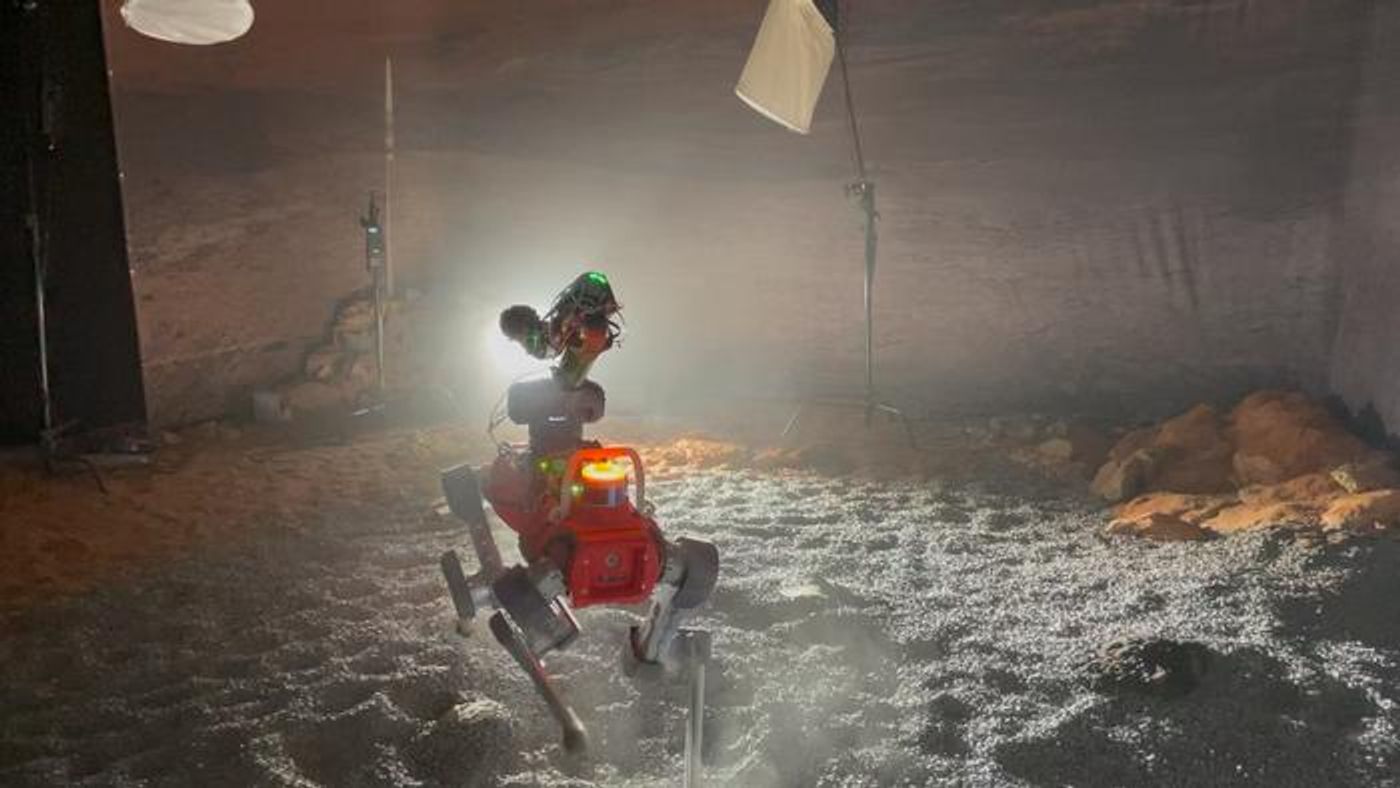
Image of ANYmal performing tests in analog sites. (Credit: Dr. Tomaso Bontognali)
The study notes in its conclusions, “Our study demonstrates that a multi-target semi-autonomous exploration approach is a viable option for geological investigations in planetary surface missions where the inability to control a robot in real-time significantly slows down exploration times and, consequently, the scientific return of the mission.”
This study comes as NASA plans to send humans back to the Moon for the first time since 1972, and having semi-autonomous robots to do surface exploration could prove useful in gaining insight into the Moon and Mars.
How will semi-autonomous robots help advance space exploration in the coming years and decades? Only time will tell, and this is why we science!
As always, keep doing science & keep looking up!
Sources: Frontiers in Space Technologies, EurekAlert!