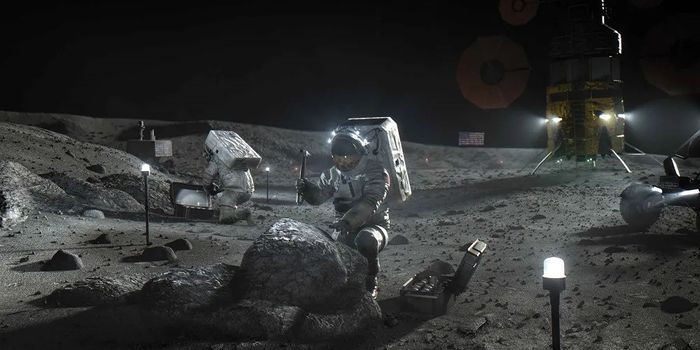
How can fiber-optic cables help scientists study the Moon? This is what a recent study published in Earth and Space Science hopes to address as a team of researchers investigated using a novel system for studying seismic activity on the Moon. This study has the potential to help scientists and engineers develop new techniques for studying the Moon and its interior, which could teach scientists about how our nearest celestial body formed and evolved.
For the study, the researchers introduced the laser-based Distributed Acoustic Sensing (DAS) technology as a novel method for identifying and measuring seismic activity on the Moon. The motivation of DAS comes from limitations and knowledge gaps with current lunar seismic data, specifically with the only dataset coming from four seismometers delivered to the lunar surface during the Apollo missions from 1969 to 1972, and which stopped working in 1977. Additionally, those seismometers only provided researchers with a limited scale, whereas the goal with DAS will be to provide a much larger sample size of lunar seismic activity, and even using a rover to lay out all the cable.
The researchers tested whether buried or unburied fiber-optic cables in lunar regolith (often mistakenly called “soil”) would be sufficient in detecting and measuring lunar seismic activity. In the end, the researchers found that buried cables provide greater measurements and efficiency compared to unburied cables. However, they also found that unburied cables that are thicker and stiffer provide the same results as buried cables.
“Fiber-optic sensing could dramatically expand our understanding of the Moon – its interior, lava tubes, landing sites, and water resources,” said Dr. Johan Robertsson, who is a Full Professor at the Department of Earth and Planetary Sciences at ETH Zurich and a co-author on the study. “Long cables could also pick up signals of tidal stresses caused by Earth’s gravity allowing scientists better understand how seismic waves travel through the Moon. It has even been proposed that DAS could detect gravitational waves exciting the normal modes of the Moon.”
How will this laser-based DAS technology teach scientists about the Moon in the coming years and decades? Only time will tell, and this is why we science!
As always, keep doing science & keep looking up!
Sources: Earth and Space Science, EurekAlert!
Featured Image Credit: Peter Rüegg / ETH Zurich