In academic and industrial protein research, speed, accuracy, and accessibility are essential. After purifying proteins using ÄKTA™ chromatography systems from Cytiva, researchers often turn to SDS-PAGE and Western blotting to confirm protein identity and assess purity (1). Even as more complex methods like mass spectrometry offer deeper molecular insights, SDS-PAGE and Western blotting remain relied upon for their unmatched speed, accessibility, affordability, and reliability.
Why validate after protein purification
Validating protein samples after purification on an ÄKTA™ chromatography system is essential to ensure that the isolated material meets the required quality for downstream applications. SDS-PAGE remains the analytical method of choice for assessing purity, confirming molecular weight, and detecting protein modifications such as glycosylation, hydrolysis, and degradation. Analytical techniques such as SDS-PAGE and Western blotting therefore continue to be powerful tools for verifying sample quality and ensuring the success of subsequent steps (1).
When combined with the Amersham™ ImageQuant™ 800 Western blot imaging system and ImageQuant™ TL analysis software, researchers can quickly perform quantitative densitometry to determine whether the purification was satisfactory or whether further optimization is needed. This rapid, data-driven confirmation helps prevent wasted time, increased costs, and delays in downstream processes (2–4).
SDS-PAGE and Western blot: accessible, proven techniques
SDS-PAGE
SDS-PAGE separates proteins based on their molecular weight (1), allowing researchers to visualize purity, confirm expected protein sizes, and detect degradation or post‑translational modifications.
Western blotting
Western blotting adds specificity by using antibodies to confirm the identity of the target protein (5). This technique is especially useful when working with complex lysates or closely related isoforms. Together, SDS-PAGE and Western blotting provide robust, orthogonal validation of ÄKTA™ chromatography system purification results.
Key benefits
These techniques are not only reliable but also accessible. They can be performed in-house with standard laboratory equipment and straightforward protocols that are easily teachable. SDS-PAGE and Western blotting deliver results in hours, not days, making them cost‑effective and ideal for grant‑funded academic research. Thousands of peer‑reviewed publications continue to cite these methods as trusted analytical tools (2–4).
Accelerating academic workflows

Time is often a limiting factor in academic labs. SDS-PAGE and Western blotting offer same-day validation, enabling researchers to quickly adjust protocols, optimize conditions, and move projects forward efficiently. Faster data generation supports manuscript preparation, grant submissions, and project milestones. By reducing reliance on external facilities, these methods minimize bottlenecks and provide research teams with greater independence.
Enhancing gel validation with digital tools
The value of SDS-PAGE and Western blotting is further enhanced by modern digital imaging and analysis tools. The Amersham™ ImageQuant™ 800 Western blot imaging system from Cytiva provides high‑sensitivity chemiluminescence, fluorescence, and colorimetric detection, producing sharp and reproducible images.
Together with ImageQuant™ TL analysis software from Cytiva adds powerful analytical capabilities. It enables densitometry, links ÄKTA™ chromatography system chromatograms to gel lanes, and includes the Similarity Score tool for objective lanetolane comparison. These analyses help detect subtle differences, such as degradation or incomplete purification, using visual outputs like dendrograms and scatterplots.
The Amersham™ ImageQuant™ 800 Western blot imaging system and ImageQuant™ TL analysis software offer a GxP-supported electronic data management functionality with an FDA 21 CFR Part 11 and EU GMP Annex 11-complaint package. The package features data integrity and traceability, including electronic signatures, and makes the systems suitable for both academic and regulated laboratory environments.
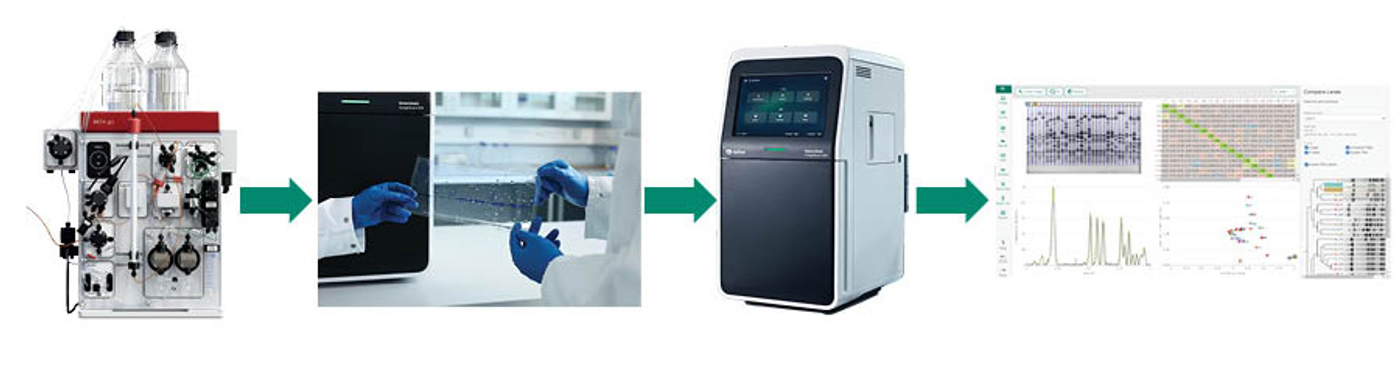
Workflow of protein purification, imaging, and analysis. The process involves protein purification on the ÄKTA go™ chromatography system from Cytiva, performing SDS-PAGE, imaging using the Amersham™ ImageQuant™ 800 Western blot imaging system, and data analysis and lane comparison using the ImageQuant™ TL analysis software.
Supporting data integrity with Image Integrity Checker
The free Image Integrity Checker tool adds an additional layer of scientific accountability and data integrity. It scans gel and blot images for signs of manipulation, such as splice lines, localized contrast adjustments, or unexpected pixel patterns, and flags any concerns that may compromise data credibility.
While it does not create an audit trail of edits, this tool strengthens good laboratory practice by helping researchers detect unintentional image errors before publication and supporting compliance with journal and grant-related image policies.
Conclusion: confident, efficient protein validation
For academic researchers worldwide, SDS-PAGE and Western blotting remain essential tools for validating protein purification (2–4). When integrated with ÄKTA™ chromatography systems, the Amersham™ ImageQuant™ 800 Western blot imaging system, and ImageQuant™ TL analysis software, these methods enable fast, accessible, and trusted workflows. The result: greater confidence in data, streamlined research cycles, and accelerating scientific discovery.
Learn more about solutions for protein research from Cytiva and sign up today to enjoy a 21day free trial of ImageQuant™ TL analysis software.
References
1. Begum H, Murugesan P, Tangutur AD. Western Blotting: A Powerful Staple In Scientific and Biomedical Research. BioTechniques. 2022;73(1):58-69. doi:10.2144/btn-2022-0003
2. Nagar G, Jain S, Rajurkar M, et al. Large-Scale Purification and Characterization of Recombinant Receptor-Binding Domain (RBD) of SARS-CoV-2 Spike Protein Expressed in Yeast. Vaccines. 2023;11(10):1602. doi:10.3390/vaccines11101602
3. Agrawal S, Padmaswari MH, Stokes AL, et al. Optimizing Recombinant Cas9 Expression: Insights from E. coli BL21(DE3) Strains for Enhanced Protein Purification and Genome Editing. Biomedicines. 2024;12(6):1226. doi:10.3390/biomedicines12061226
4. Flottmann F, Pohl GM, Gummert J, Milting H, Brodehl A. A detailed protocol for expression, purification, and activity determination of recombinant SaCas9. STAR Protoc. 2022;3(2):101276. doi:10.1016/j.xpro.2022.101276
5. Yang PC, Mahmood T. Western blot: Technique, theory, and trouble shooting. North Am J Med Sci. 2012;4(9):429. doi:10.4103/1947-2714.100998
Cytiva and the Drop logo are trademarks of Life Sciences IP Holdings Corporation or an affiliate doing business as Cytiva. ÄKTA, ÄKTA go, Amersham, and ImageQuant is a trademark of Global Life Sciences Solutions USA LLC or an affiliate doing business as Cytiva. Any other trademarks are the property of their respective owners.
© 2026 Cytiva
For local office contact information, visit cytiva.com/contact